
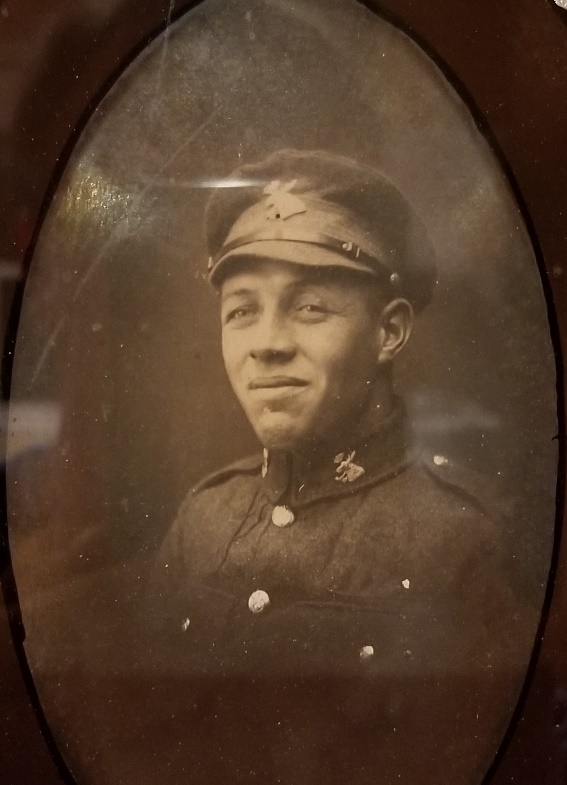
838214 Pte Hugh Wright was born on October 20th, 1892 in Meaford, Grey County, Ontario, to George and Frances. By the time war was declared the Wright family had moved to the farming community of Elmwood, located on the Grey/Bruce County line.
Deciding to join up, Hugh initially enlisted in one of the two independent rifle companies being raised for overseas service, by the 31st (Grey) Regiment. Already under arms, all the men from these two companies would be reassigned to the new Canadian Expeditionary Force overseas battalion being raised in the county.
Twenty-three year old Hugh attested into the 147th (Grey) Battalion on December 7th, 1915. With no facilities to house the unit over the winter, the soldiers where billeted and trained locally, until the unit left for training at Camp Niagara in May of 1916. As the conditions in the Camp were wanting the unit moved to the new training facility of Camp Borden in late June. At the end of September, the unit received their orders to proceed overseas, but they were detained in Amherst Nova Scotia for over a month when a number of soldiers contracted diphtheria. The unit finally sailed for Great Britain, on November 14th, 1916, aboard the S.S. Olympic.
On January 1st, 1917, the 147th Battalion ceased to exist when it became the nucleus for the 8th Reserve Battalion, whose task it was to supply reinforcements to the 58th and 116th battalions as well as the 4th C.M.R. Private Wright was taken on strength of the 4th C.M.R. on April 22nd, 1917 as part of a reinforcement draft after the Battle of Arras, the battle where the Canadian's stormed Vimy Ridge.
After the Battle of Hill 70, the 4th C.M.R., continued its rotations in and out of the line, while the Canadian Corps conducted operations in preparation for its next major battle. It was during this time, while the unit was in the support lines near La Chaudiere, that it came under a mixed artillery barrage, of High Explosive and gas shells during the early hours of September 5th. When the bombardment started the soldiers would have automatically taken precautionary gas measures by donning their gas masks, and then put them away when the all clear was given. Unbeknownst to them the gas shells that had exploded contained Mustard Gas, that initially had little effect due to the cold weather, which caused it to pool in the low ground, where it lay dormant until it began to vaporize with the rising sun. Catching the men unprepared, this new form of gas inflicted over 100 casualties on the unit. Hugh would be among the wounded suffering from the effects of the gas, and making his situation worse he had also developed Trench Fever.
Through the medical system, Hugh was eventually admitted into the war hospital in Reading, England. It was here that Hugh would meet and fall in love with Florence Jane Allen, who would become his wife after the war.
Declared fit for active service, Hugh made his way back to the front, reporting into his unit on August 14th, 1918. Having just missed the major battles at Passchendaele and Amiens, Hugh was with the unit during the final battles of the Great War: Arras, Cambrai and the Pursuit to Mons. It was during this pursuit that, just three days before the Armistice came into effect, Hugh was gassed a second time. Once again he was medically evacuated to England and as he wasn't fully recovered when the 4th C.M.R. returned home. He was left behind serving in the 3rd Reserve Battalion.
,br />It wasn't until the end of March 1919, that Hugh finally sailed home. Departing from Glasgow, Scotland, aboard the S.S. Saturnia, Hugh disembarked at Saint John, New Brunswick. From there he took the train to Toronto. Making his way to the Canadian National Exhibition grounds, he reported into No. 2 District Depot dispersal unit for processing. It was there that 838214 Private Hugh Wright was struck off strength of the 4th C.M.R. and discharged from the Canadian Expeditionary Force on, April 11th, 1919.
After his discharge, Hugh returned to Elmwood and the family farm. In August, Florence arrived from England and the couple were married in the Town of Chesley, on September 17th, 1919. Hugh and Florence purchased a farm of their own in Bruce County, where the raised their family. Hugh passed away in 1963 and was laid to rest in Elmwood's cemetery, where he was joined by his wife, Florence, three years later.
Biography credit: George Auer