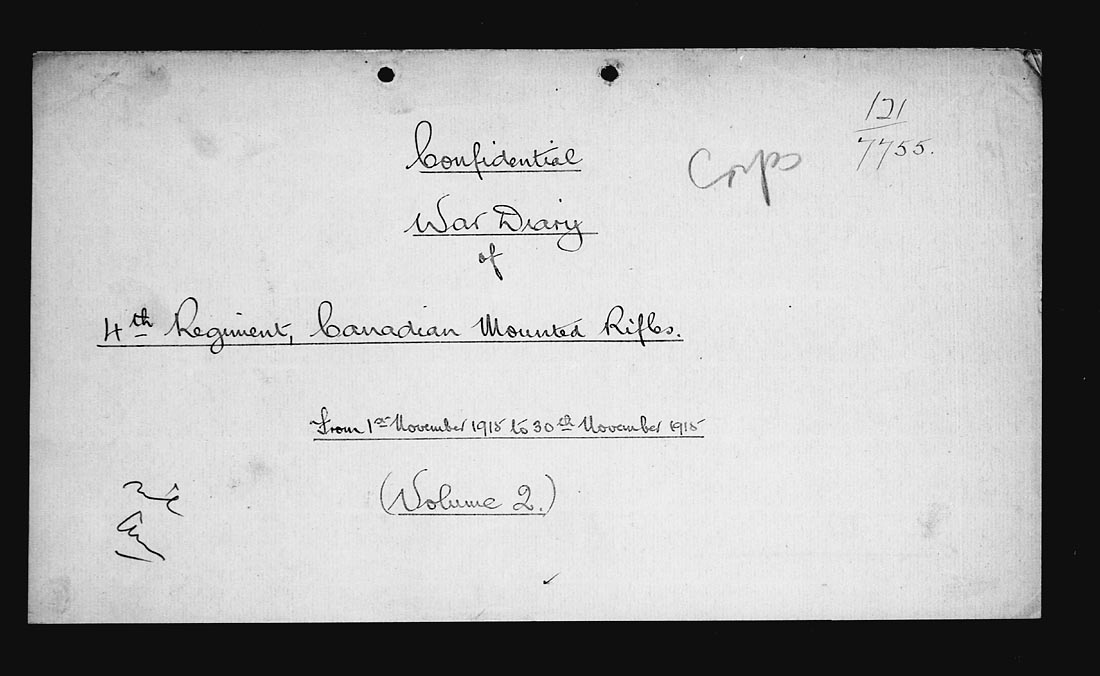
The following presents a work-in-progress overview of the 4th CMR's history, with details being taken from the Regimental History, by S. G. Bennett (1926) and cross-referenced with the War Diary. You are encouraged to read these documents for fuller details on the abridged activities and actions shared here. Links to the War Diary (Research and Honourary Websites) and the History (Bibliography) can be found on the Links page.
4th Canadian Mounted Rifles - Formation and Movements
The 4th Canadian Mounted Rifles became a unit of the Canadian Expeditionary Force on 5th November, 1914. Under the command of Lt.-Col Vaux Chadwick, former commanding officer of the 9th Mississauga Horse, its personnel, established by twenty-eight officers and five hundred and seventy-seven non-commissioned officers and men, were drawn from the Governor General's Body Guard, the 2nd Dragoons, the 9th Mississauga Horse and the 25th Brant Dragoons.
In 1936 the GGBG and 9th MH combined to become The Governor General's Horse Guards, which perpetuates the 4CMR today as part of the 32nd Canadian Brigade Group.
Nov 1914
First known as the Ontario Mounted Rifles, then subsequently named 4th Canadian Mounted Rifles, the regiment was brigaded with the 5th & 6th CMR in the 2nd Canadian Mounted Brigade, and on Nov 16th, 1914, was billeted at the Canadian Exhibition Centre. In addition to starting out with around 200 horses, bought by the City of Toronto and Lt.-Col. H. C. Cox - Hon. Col. of the Mississauga Horse - a further 500 horses were received, but bridles and saddles were lacking and for the first three months had to be borrowed from the Mississauga Horse. Early training was therefore conducted bare back as a consequence. A hard winter was endured with the help of additional winter clothing being bought and donated by the good people of Toronto.
Spring 1915
The Governor-General, H.R.H. the Duke of Connaught inspected the unit and commented in glowing terms on the splendour of its appearance. This visit was rumoured to be a precursor to deployment to Egypt. This hope was not fulfilled and the Regiment's hopes for action further shattered when called upon to hand over their horses as chargers for the officers of the 2nd Canadian Division then heading overseas.
May 1915
The Regiment reservedly accepted an invitation to volunteer for service overseas as a dismounted unit, and soon after were moved to Niagara-on-the Lake for continued training.
June 1915
The Regiment is moved to Valcartier, joining with the 5th & 6th CMR under Col. C. A. Smart to form the 2nd Canadian Mounted Brigade. Lt. Col. Vaux Chadwick is transferred to HQ as Brigade Major of the 7th Overseas Infantry Brigade, putting Lt. Col. Sandford F. Smith in command, and Lt. Col. H. D. Lockhart Gordon as Second-in-Command, and training continues in earnest.
18th July 1915
The Regiment boarded the S.S. Hesperian at Quebec, which carried the 4th and 5th CMR, and Brigade HQ Staff, to England.
29th Jul 1915
The Regiment arrives and disembarks at Plymouth and entrains for Shornecliffe, arriving later to march into tent billets at Dibgate Hill, Kent. Training commences quickly thereafter, with manoeuvres on the Downs, and musketry practise at Hythe, over the following two months.
23rd Sept 1915
The Regiment moves to Caeser's Camp, where they receive Webb equipment, ammunition, and identity discs.
24th Oct 1915
The Regiment marches to Folkestone and sails for Boulogne, France. Disembarking at 10pm they march to St.Martin's camp on the hills overlooking the town.
26th Oct 1915
Entraining at Boulogne the Regiment moves east to Bailleul, detrains and moves on to billets three miles from the town, within ear-shot of the guns.
2nd Nov 1915
Moved east of Bailleul, to Aldershot Huts, near Neuve-Eglise, Belgium, and attached to First Canadian Division for final lessons in trench warfare, with alternate squadrons going into the trenches south of Messines near St. Yves for 48 hours at a time.
22nd Nov 1915
After returning to Bailleul for a few days' rest, bath-parades and sports, the Regiment moves to Bulford Camp, with the Transport at nearby English Farm.
23rd Nov 1915
Occupying trenches near Hill 63, Ploegsteert, the Regiment spends four days in the front line and four days in Divisional Reserve, as it takes up its first defensive responsibility for part of the British Line.
1st Dec 1915
The first losses are experienced. Pte W. Fulford is killed and five men wounded, with L/Cpl Hodge (acting Chaplain) dying of wounds, in a shell burst over “A” squadron billets in the forward area. Pte R. Craig is killed in a listening post in a forward sap the following day.
3rd Dec 1915
Lt. Rutter, two officers and a ten men of “C” Company volunteer for a raiding party on a barrier on the Wulverghem-Messines road. Planning to get prisoners for identification purposes, the raid was scattered by enemy fire drawn by allied screening fire and three men were killed, with four further being wounded.
22nd Dec 1915
The Third Canadian Division is formed, commanded by Major-Gen. Mercer. The then six CMR regiments were converted into four battalions of infantry (having maintained a cavalry establishment up to that point), making the 1st, 2nd, 4th and 5th Battalions into the 8th Brigade under Brig.-Gen. V. A. .S. Williams. The 7th Brigade was made of up of the P.P.C.L.I, the R.C.R., the 42nd and 49th Battalions. The 9th Brigade was made up by the 43rd, 52nd, 58th and 60th Battalions. Command of the 4th CMR was put under the hand of Lt.-Col. Sandford F. Smith, who subsequently moved on to be replaced Major J. F. H. Ussher, who became Lt.-Col a few weeks after.
Christmas 1915
In rest billets, Dec. 25th was passed with Christmas dinner, home comforts and sports in the afternoon.
January 1916
In Corps Reserve, infantry drilling continued under the hand of the 7th Brigade, and it is recorded that H.R.H. the Prince of Wales made a visit on Jan. 27th, although no note of any preparations or the actual event was made in the 4th CMR War Diary.
1st Feb - 18th Mar 1916
8th Brigade relieves the 3rd Brigade, spending three weeks rebuilding, revetting and draining trenches in trying conditions on the Wulverghem-Messines road. They move out to rest billets and on Mar 18th are moved north to “B” Camp, three miles east of Poperinghe.
19th Mar - Apr 6th 1916
Amidst cold and raw weather, the Regiment take over trenches in front of Zillebeke, south-east of Ypres. After spending four days in the line, during which time four men were killed and five wounded, the Regiment is relieved by the 5th CMR and moves out to “Belgian Chateau” in Brigade Reserve until Mar 28th, when they return to the front line and then go back to Brigade Reserve again until Apr 6th when the go back to “B” Camp for a week of rest.
13th - 29th Apr 1916
The 52nd BN are relieved as the Regiment takes up trenches close to Armagh Wood, near Zillebeke, where they split their time between the front line, local support and Divisional Reserve. The Regiment is relieved by the P.P.C.L.I. on the 29th, and they return to “B” Camp for rest.
May 1916
The Regiment returns to the front line, relieving the 58th BN Canadian Infantry in the Sanctuary Wood area on May 6th. Having undergone some heavy shelling on May 11th, the Regiment was relieved by the 5th CMR on the 16th and moved back to Camp “F” for two weeks rest, drill and bath parades, and providing work parties at the front. The Regiment is moved to “B” Camp on the 22nd and then is moved back to the front line on the 31st, relieving the 52nd BN, taking trenches 47 to 53 in front of Armagh Wood. The 1st CMR are to the Regiment's left, holding trenches 54 up to 60, and the 5th BN Canadian Infantry, are to the right, holding trenches 46 to 38.
1st June 1916
“A” Company suffered two casualties from trench mortars sent into the right sector of the Regiment's line. In the early afternoon a large group of enemy soldiers digging wide shelter trenches in front of Trenches 51 & 52 were dispersed with Lewis & Stokes machine guns. Enemy was reported as very quiet on the night of June 1st/2nd, and so a large working party from the Regiment was out working on a sap and new trench in front of Trench 51 during the night.
2nd June 1916
Divisional Commander, Maj-Gen. Mercer, with A.D.C. Capt. L. E. Gooderham, Brig.-Gen. Williams and Brigade Orderly Officer, Capt. Fraser, were making a visit to the front line, with Lt.-Col. Ussher. Around 8am the enemy commenced a very heavy and unprecedented bombardment. A shell landed opposite the visiting party, deafening General Mercer and Lt. Gooderham, and slightly wounding Brig.-Gen. Williams. The intense bombardment kept up for 5 hours without cessation, with three mines being sprung about 1pm on the Battalion front. Maj.-Gen. Mercer was further injured and died in the subsequent evacuation, whilst Brig.-Gen. Williams and Lt.-Col. Ussher were taken prisoner with over 100 men. The trenches were tilled flat by the rain of steel and high losses meant there was little (albeit ferocious) resistance against the advancing Wüttemberg troops. The enemy had gained some 300 to 700 yards along a varied front, but failed to consolidate their gains.
The details of the wider picture on what turned into a much longer engagement (some 14 days in all) can be read through the extensively detailed "Battle for Mount Sorrel" page on Chris Baker's excellent www.1914-1918.net website.
Official histories and reports infer that the losses for the 4th CMR were 89% casualties. It is believed that whilst this figure was genuinely held due to the chaos at the time, it was never fully examined. Subsequent analysis of the figures indicates that indeed whilst this was a black day for the 4th CMR (and the 1st & 5th CMRs), losses for the 4th CMR were actually between 15% and 33%, depending on which Regiment strength figures one uses. For an exploration of this theme, see the 4cmr.com article on the matter entitled: 'The Missing Lost. A 4CMR Myth?'
3rd - 21st June 1916
The Second-in-Command and 64 survivors move back to Camp "B" and the Regiment, such as it was, was ordered to move on to the rest area at Steenvoorde on June 5th. A draft of twenty Other Ranks arrived from the 12th Reserve Battalion on the 6th, and Major Lockhart Gordon arrives to take command of the battalion on the 7th. A draft of 498 O.R. arrives from 33rd, 81st and 83rd Reserve Battalions on the 9th. By degrees the Regiment reformed, trained and drilled back to a fighting force.
22nd June 1916
Gen. Sir Julian Byng, Army Corps Commander visits in the morning, and all officers are addressed in the afternoon by Gen. Sir Julian Byng, Gen. Sir Herbert Plumer G.O.C. 2nd Army, Gen. Lipsett G.O.C. 3rd Canadian Division, and Col. Elinsley G.O.C. 8th Brigade.
25th June - 12th July 1915
Battalion moves to Cavalry Barracks, Ypres, and working parties are provided for the front line over the next few days. They move back to billets at Steenvoorde on the 28th and continued drill and training into July.
13th - 22nd July 1916
Moved up to Camp St. Lawrence on the 13th, and joined by 100 O.R. that night. Onto Ypres and Cavalry Barracks the following day. Supplied working parties for duties at the front until the 18th. One man killed and four wounded during this time. Moved to Zillebeke Bund on the 18th, and supplied working parties for five nights. 6 more casualties.
23rd - 31st July 1916
Relieved the 5th CMR near Sanctuary Wood on the 23rd, occupying trenches that formed the old battle line of June 2nd. The enemy was quite active throughout. Further losses during this time. Relieved by the 58th Battalion on the 27th and moved to Erie Camp, then into billets at Steenvoorde on the 31st.
1st Aug - 6th Sept 1916
Prior to moving to Camp Winnipeg on Aug 8th, the Regiment was occupied by a great deal of training and supplied men to all manner of working parties. Relieved the 14th BN at Swan Chateaux on Aug 9th, and with a few intervening casualties subsequently went into the front line to relieve the 5th CMR on Aug 16th at "The Bluff", a southerly position near the Ypres-Comines canal. Relieved by the 2nd Essex BN on Aug 22nd, the Regiment moved back to "D" Camp, and then transferred to billets in North Steenvoorde on the 23rd, where they stayed until Sept 6th.
7th - 14th Sept 1916
Moved out from the Ypres sector and after overnight train journey, arrived at billets in Franqueville, on the Somme on the 8th. After a day and a half here they were moved on and after a circuitous couple of days, arrived by busses at Albert on the 11th, where they moved by platoons to the brick-fields north of the town. Surprisingly they were moved into the front line at Mouquet Farm, Pozières, the same evening, being bombarded with gas shells as they relieved the 5th BN. There for two days, they were relieved by the 5th CMR on the night of 13th/14th.
15th - 26th Sept 1916
The general attack on Courcelette was launched on the 15th, seeing the new "Tank" make its debut whilst five divisions of Cavalry waited to seize any opportunities afforded by a breakthrough. The 4CMR was sent in to help push the advantage at 5pm as pivot troops for the larger flanking movement. Whilst 'C' Company suffered platoon losses under withering machine gun fire, by 11pm the situation was under control with the 4CMR in front of the infamous Zollern Redoubt. With 50 German prisoners and two captured machine guns to their credit, to the loss of 34 men and 52 wounded, they were relieved by the Lancashire Fusiliers on the evening of the 16th. They returned to Albert and rested until the 19th, when they were marched to Warloy. On the 20th they headed back towards the front at Bouzincourt, where they spent the following week.
27th - 30th Sept 1916
The regiment headed back to Albert and on through to Tara Hill, behind Pozières, where they releived the 8th and 10th BNs in support of the 1st & 2nd CMRs who were occupying the front line. They spent three days in support before relievingthe 2nd CMR at 7pm on the 30th.
1st - 13th Oct 1916
Now 1,000 yards in front of the ground they had helped take in mid-September, they were sent in to help take Regina Trench. This proved very costly as Regina Trench was not fully captured and held. Relieved by the 49th BN on the night of the 2nd/3rd, the Battalion went back to Albert for five days before returning for three days of intense and often costly, dangerous work in the support trenches.
14th - 31st Oct 1916
By circuitous route, the 4CMR marched for Vimy, arriving in Maroeuil, a Divisional Reserve area for the Vimy front, on the 22nd. Here it stayed for a further two days, before going into the front line area once more, relieving a London Regiment in communications trenches in front of Ecurie on the 24th. This was a peaceful sector by comparison to the hell they had recently endured, and here they stayed until they went forward to hold the front line trenches on the 31st.
November & December 1916
Maintaining a routine of four days in the front line, four days in relief, at Etrun, the Battalion saw November & and December through with just a few losses and plenty of continued training in musketry, bombing, smiping and route-marching.
17th Dec 1916 - 15th Jan 1917
A fake attack by the 4CMR on the 17th, to cover actions of the 1st CMR to their left, proved so convincing that the enemy concentrated a heavy retaliation bombardment on the 4CMR's front, inflicting so many casualties that the fake attack had to be abandoned. On the 23rd they returned to Etrun, going in to Divisional Reserve, where they spent their second Christmas; noting that few with the Battalion now were in it on the previous Christmas. The Battalion continued activity in the front line on January 1st, doing turn-about reliefs with the 2nd and 5th CMRs.
16th Jan - 5th Feb 1917
Relieved by the 5th Cameron Highlanders on the 16th, the Battalion marched to billets at Maroeil, where they stayed until moving on to huts in Bois-Les-Alleux on the 18th. On the 21st they relieved the 5th CMR in Brigade Support and then returned to the front line trenches, relieving the 1st CMR in the left sub-sector at Ecurie on the 29th. They stayed there until February 5th, when they left the front line for several days at Mont St. Eloy.
11th Feb - 17th Mar 1917
Embarking on a long march to receive training and "rest", the Battalion settled down to five weeks of arduous training.
18th - 31st Mar 1917
On the 18th the Battalion set off and returned to the front line, relieving the 60th Canadian Infantry BN (9th Brigade) at Pylones. A mine was blown to the left of their front at 3am on the 23rd, but no effort was made by the enemy to occupy the crater. The Battalion remained in the front line until relieved by the 60th and the 52nd Canadian Infantry BNs on the 31st.
1st - 8th Apr 1917
Moving back to rest billets at Villers-au-Bois, final preparations were made for the attack on Vimy Ridge over practise trenches. The night ofthe 5th/6th saw them back in the same line, relieving companies of the 52nd and 60th BNs. On the night of the 6th, two parties went forward and cut the wire at "P" line and the following night between Albany, Devon and Vernon craters. The 8th saw preparations at the concentration points for the attack planned for 05:30 on the 9th.
9th - 11th Apr 1917
Within two hours of "the off", following supreme efforts, the 4CMR had achieved its goals and had occupied the enemy front line and support trenches, having played a significant part in the taking of Vimy Ridge. The cost had been one officer and 43 men killed, five officers and 131 men wounded. Further actions to push a patrol out to Petit Vimy on the 10th discovered a force of Germans with a machine gun still in the sunken road to La Folie Wood. This was bombarded as a result the following day. The 11th also saw the 4CMR involved in actions to "dislodge the enemy" from a trench system on the reverse side of the Vimy Ridge slope. Working in open ground much of the way, action here saw them being shelled for four hours to the loss of one officer and 7 men killed, and 20 men wounded. Holding the line for 65 hours without blankets, great coats, or much in the way of any sleep, a very tired Battalion was relieved from extremely trying conditions by the 52nd and 60th BNs in the midst of a snowstorm on the night of the 11th. The Battalion trudged back to Neuville St. Vaast, into very poor accomodation at Dumbell Camp.
12th - 21st Apr 1917
Hard work was put in to improve the situation at Dumbell Camp, in relocating it to higher ground, before being moved on to bivouacs at Fort George on the 16th. Here they supplied 600 men working parties to rebuild roads around Le Follie Wood and for works under the town mayor in Neuville St. Vaast. On the night of the 18th/19th, the Battalion relieves the R.C.R (Royal Canadian Regiment) in support around Pylones and continues salvage and road repair work. On the night of the 21st/22nd the Battalion relieves the 5th CMR on the Outpost Line on the Vimy line in front of Ashville, Mericourt and Avion.
22nd - 30th Apr 1917
Working patrols on the 22nd, the Battlaion was ordered, on the 23rd, to advance its left flank line in co-operation with the 5th Division. Whilst the 4CMR reached their objectives, the 5th Div. did not and the 4CMR drew back under enemy counter-attack, which was broken up by prompt action of the 4CMR machine gunners. The P.P.C.L.I and the 49th BN relieved the 4CMR on the night of the 24th/25th, and they moved back to shelters at Fort George, then to buillets in Villers-au-Bios for a few days of pay parades, drill, P.T. saluting, kit inspections, sports, Church parade and finally on the 30th, full Battalion parade.
1st - 13th May 1917
Moved back to shelters at Pylones on the 1st and relieved one Battalion of the 7th Canadian Infantry Brigade. Supplied 4 companies of working parties to the 3rd Canadian Railway Company on the 2nd, whilst the remainder continued salvaging wire and equipment and cleaned up camp through to the 6th. Then moved up to support at La Folie Ridge in relief of the the 5th BN, taking 6 casualties in the process. Supplied working parties through to the 10th, when moved up to relieve 2 companies of the 1st CMR in the front line - under 4CMR orders - and one company of the 2nd CMR in the support lines, in front of Mericourt. Patrols sent out on the night of the 11th could hear the enemy shouting and transport moving in Mericourt. A 30 aircraft dog fight was observed at 7pm on the 12th. The R.C.R. relieved the Battalion after midnight into the 13th.
14th - 27th May 1917
At Villers Camp, Villers-au-Bois on the 13th, they settled in as Divisional Reserve, spending the time through to the 20th on training in extended order and physical and arms drill, interspersed with concerts and sports. Inter-brigade best platoon competition was won by 5th CMR, with 4CMR's A platoon coming 2nd despite having now formal training in the new formation drills. A "Lewis gun was set up in suitable position in comp area for use against low flying hostile aircraft". On the 21st, the Battalion, remaining in Divisional Reserve, took over from the R.C.R. in support at Quarrie Site, bivouacing at Toronto Camp. Two Lewis guns were set up to defend against hostile aircraft. Working parties continued despite harrassment from enemy aircarft through to the 27th. Of note, as detailed on Pte. McCabe's page, during a baseball game on the 26th, Pte. Clarence McCabe picked up a "blind" (unexploded) shell, which went off, killing him, 8 others and wounding a further 11.
28th May - 11th June 1917
Battalion moved off from Quarrie Line on the 28th to relieve the 116th BN in Brigade Support and on the 29th resumed the supply of working patrols through to the 2nd of June, when it then relieved the 1st CMR on the front line in front of Mericourt. Working parties and reconnoitering continued on the front line, preparing jumping off points for a coming action. In the early hours of the 5th, an organised ambush of a 25 strong German patrol secured one unwounded German prisoner. Enemy gas shells were discharged on the left of the 4CMR's line on the 6th. Work continued with jumping off points and protective patrols, repelling of enemy aircraft and scattering of enemy patrols, through to the 9th, when the Battalion was relieved by the P.P.C.L.I. in the early hours of the 10th. The 4CMR moved back to Winnipeg Camp inthe Quarries area (still in the immediate area of Vimy Ridge), and supplied working parties to the 123rd Canadian Pioneers for cable burying duties on the 10th and 11th.
12th - 30th June 1917
The Battalion moved to Divisional huts at Villers-au-Bois on the 12th and underwent kit inspections and partook of much needed baths on the 13th. Drilling and "speciality training" on-going to the 18th, when the Battalion relieved the 116th Canadian Infanty Brigade in the right subsection on the east side of the Bethune Road. The front line was held until relieved by the 10th Canadian Battalion and 1st CMR on the 22nd. Moved back to Brigade Reserve and newly reconnoitered accomodation in and around Vimy. Working parties supplied up to the 26th until relieved by the 116th Battalion and moved on to Villers-au-Bois, where they moved in to Surburban Huts on the 27th. Inspections and medical attention to feet given through to the 30th.
The sources for the above summary are: the 4CMR War Diaries, and S. G. Bennett's extensive 4th CMR Regimental History.