
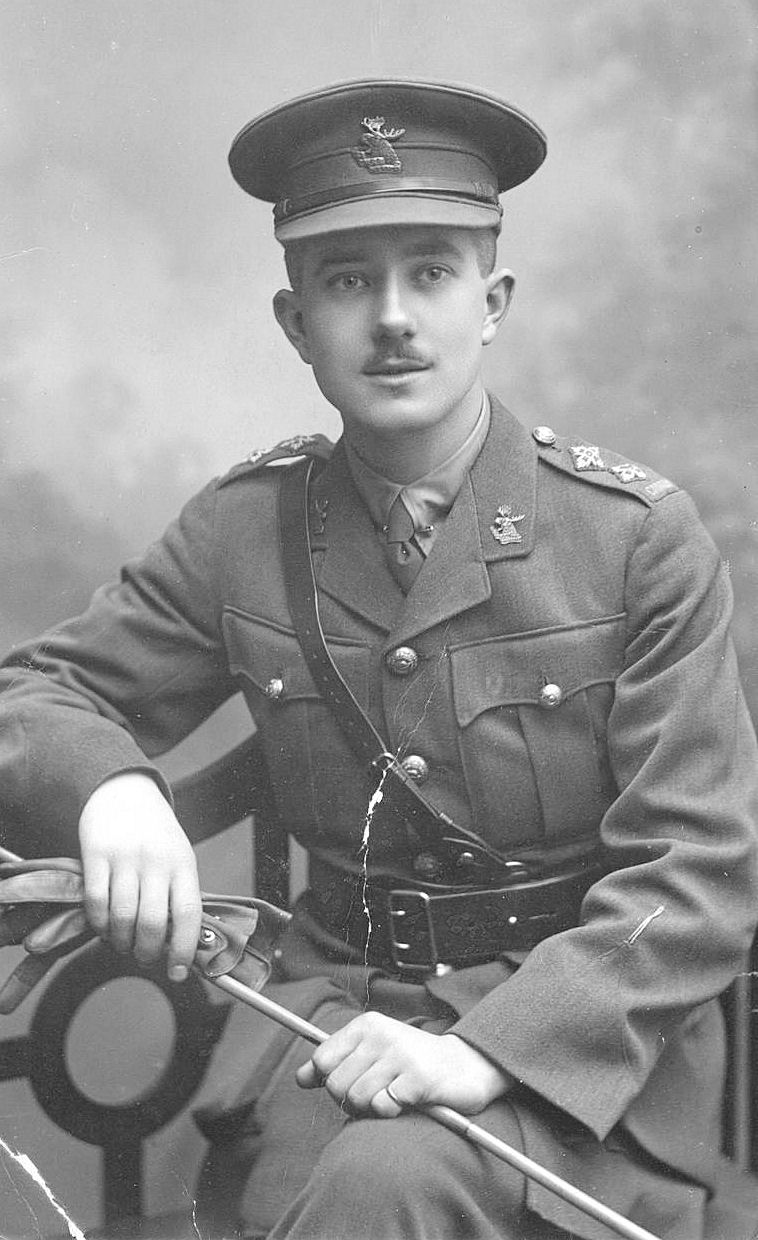
Lt. Vernon Charles Dowling was born in Hackney, London, on 8th July 1892 to Charles James Dowling and Caroline Hurlin. He was the elder of two sons. After completing compulsory schooling, Vern took employment with Booth & Co. at London Bridge early in 1907. He was fourteen and a half years old. He left in February 1910 because there "was no immediate chance of a promotion." His letter of referral spoke of his "fertile and ingenious brain" and "abilities distinctly above average." He would be of the "greatest assistance to his new employer."
In the autumn of 1911 Vern, then age 19, immigrated to Canada. On a farm near Brampton, Ontario, a pig farmer employed him. Living conditions were harsh. His quarters were in the barn above the sty. A wire attached to a bell was strung to the barn from the farmer's house so that Vern could be summoned wherever the farmer wanted, sometimes at night.
After some months Vern found new employment as a clerk for the Canadian Bank of Commerce, in Brampton. Among other duties, he was required every Wednesday to take a horse and buggy, a cash box and a revolver, into the country where, at a prescribed location, he waited for farmers to cash their cheques. They rarely came. Vern spent these afternoons shooting cans from the top of fence posts.
The Military
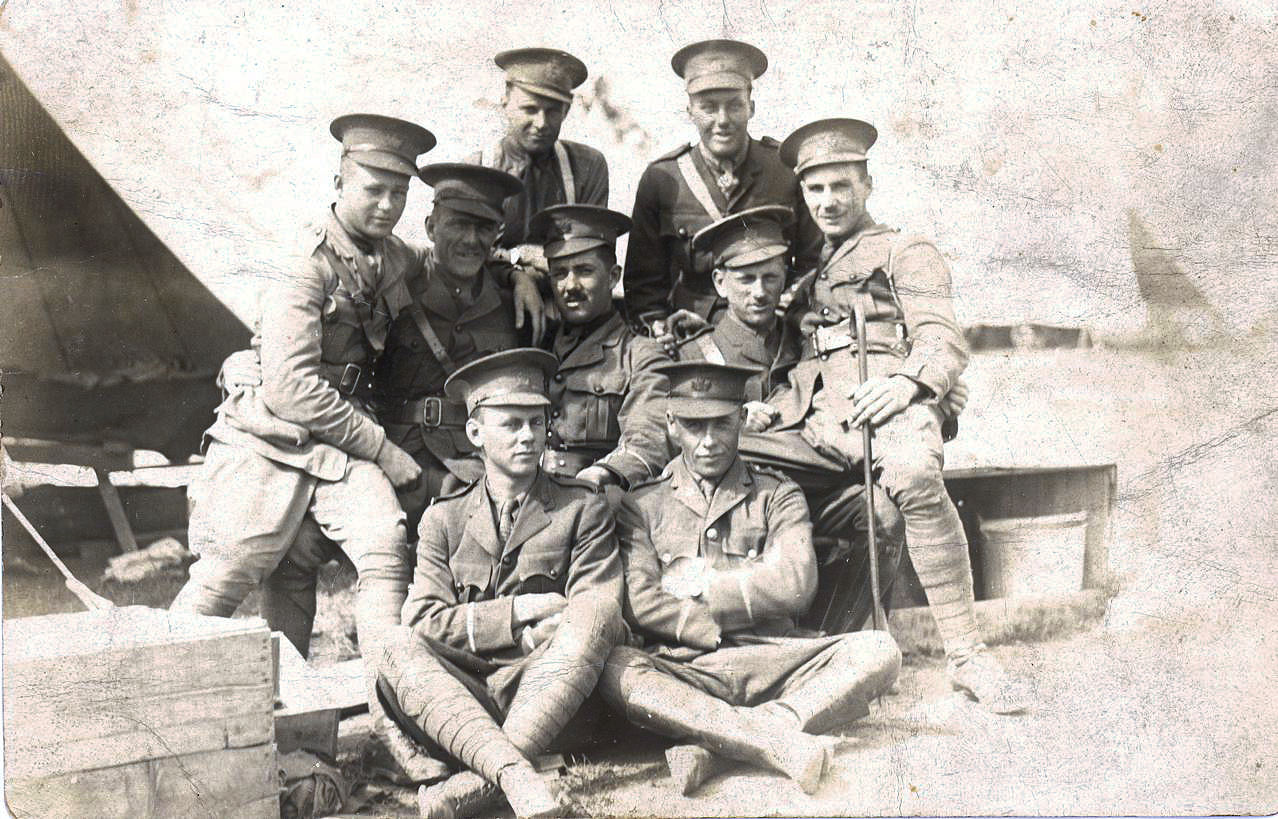
In October 1914 Vern joined the Canadian Militia, the 26th Regiment (Middlesex Light Infantry). He qualified as Lieutenant in November and Captain in December. Click on the image below right. Vern is centre with a group of fellow officers. On 3rd July 1915 he was attached to the 59th Battalion CEF and on 28th September he was appointed to commissioned rank as a Lieutenant. At the beginning of April 1916 he returned to England as a soldier.
Soon after arriving Vern wrote to Miss Edith Winn of Clapton, South Hackney, who he had known since his earliest school years. She remembered Vern as a "mere youth" when he left for Canada. Now, five years later, he had returned a "handsome officer in the Canadian Army!"
One of Vern's last duties with the 59th ('B' Company) was to command the night guard at the Folkestone Water Works on 12th June. The 59th was being broken up to supply reinforcements to units that had lost troops near Ypres, "the bloody salient," in Belgium.
Vern was attached to the 4th Canadian Mounted Rifles (4CMR) and joined it in the field on 18th June 1916. He was one of a second draft of officers replacing nineteen officers killed, wounded, missing or captured at Sanctuary Wood on 2nd June (the Battle for Mount Sorrel). Upon his arrival at Battalion HQ, Vern found morale "very low."
Ypres Salient
The history of the 4CMR is well documented and easily accessible. In later years Vern recalled events that specifically affected him. These he related to his family in personal conversations, by letter and a recorded interview before his death. He claimed to no longer remember precisely every detail but he left no doubt as to the deep impressions the war had made on him. In a letter written in 1955 he gave some details:
"The fighting in this area [Ypres Salient] was static; possible [sic] no traces remain today but for political expediency it was considered necessary to keep at least a portion of Belgian territory. Ypres was the key point. [When in Ypres], I was billeted in the Cavalry Barracks near the Lille Gate. [I slept] on the cobbles in the horse stalls on the right side of the entrance. See if the swans are still in the moat outside the gate.
We were near Zillebecke [sic] and Kemmel most of the time. It is hard to believe that in this area alone, thousands died. The maps indicated we were completely enfiladed [open to sweeping gunfire]."
When on leave during rest periods, Vern took refuge in Talbot House, a residence for officers, on the main street of Poperinghe, a town eleven kilometres west of Ypres. Although distanced from the line of fire, the inhabitants of the town were never beyond the sound of the big guns.
Vern spent little more than two months in Flanders. For much of this period he led nightly work parties, moving supplies to the front line along duck-boarded communication trenches and returning by dawn. His first experience under fire occurred in late June, when the battalion was sent to the front line for a few days of instruction. Only on 23rd July did the "new" 4CMR take over responsibility for a portion of its old position around Sanctuary Wood. Although the enemy was only a gunshot away, the line was very static, both sides equally open to attack by the other. "Every now and then Gerry would lob over a shell or two to get our attention but otherwise it was pretty quiet. " Even though no major offensive by either side took place, casualties still occurred. Snipers were at work.
In an interview Vern gave late in life, he described the battle positions for both sides:
"Well, you see, the change in terrain was only a matter of, sometimes feet or inches per day, sometimes, not at all ... completely static. A gain of a few hundred yards [would] be held as a tremendous advance because we were attacking against prepared positions. Highly fortified. And they were pretty hopeless to take over unless there was great preparation taken ahead of time in the form of artillery or mortar fires [sic]. The situation in every case until the latter stages of the war was that everyone knew where everyone was because the British took over the German trenches. [And the Germans took over the British trenches] ... because they were all photographed and mapped exactly to scale. So it was a question of adjusting the sights on the guns to lob a shell or two over. In fact, both sides were sitting ducks. That's why they had such high casualties.
When there was what they called an offensive on a large scale, it meant using tremendous numbers of men and tremendous amounts of firepower. And that was why casualties were so high."
While waiting to move forward near Zillebeke Lake, Vern and his men were once bombed by a German aircraft flying very low. The bombs were dropped by hand. "They didn't hit anybody," he said and the Canadians didn't shoot back because "they didn't have orders to fire. Nothing was done without orders."
The battalion remained in the front line until 27th July and then returned to work parties on 8th August. By the 15th it was back in the line for seven days until relieved on the 23rd. Vern and his men would leave the Salient, most of them never to return.
The Somme
The battalion was ordered from Ypres to take part in a major offensive already underway along the Somme River in France. Vern recalled the strenuous effort required of the battalion to move to their new forward position starting 7th September. On the 11th it had repositioned along the Albert - Bapaume Road to Pozieres to relieve the 5CMR. That evening, the 4CMR left Pozieres and came under a gas attack.
"I did experience gas in the early days on the Somme when the Germans sent over phosgene gas shells. And I was caught. We had gas masks - a flannel hood with a metal piece and a rubber piece attached that you could breathe through. Well, the result was that you had it on for about two minutes and nearly suffocated. You were forced to take it off. Early gas masks were nearly useless. Phosgene smells sickly sweet, something like a concentrated pear ... greyish in colour, a mist."
Two days later, on the night of the 14th-15th September, the men of the battalion were taken by surprise:
"We had taken a place called Mouquet Farm and were going down to support the 22nd Regiment, the Van Doos. They were to attack a place called Courcelette. We went to support them along the Pozieres Road. But in going down the road overnight to their position - we were pretty tired, sluggish - all of a sudden we heard shouts of laughter. We didn't know what it was. We came to life and got down a little way along the road and we heard this noise - 'chip, chip, chip' of a tank. We didn't know of the existence of a tank at that time. Never heard of it. This was [one of] the first tank[s] that went into action... they called it the Crème de Menthe."
The following day, Vern and his men watched this and other tanks go into action for the first time.
For the next two weeks, the battalion was in and out of the line three times before finally relieving the 2CMR on the night of 30th September. By 2am, 1st October, they occupied their new forward position and were given a new objective: the well-positioned and well-defended Regina Trench, behind a ridge called Ancre Heights. The Trench was later labeled "the ditch of evil memory."
Regina Trench
The trench lay beyond the crest of the ridge and could not be seen from the attacking position. Unfortunately, supporting artillery fire, intended to cut the barbed wire, did not hit its target and could not be corrected because the ridge obscured the artillery observers' line of sight. In addition it was raining and the Germans were ready.
On 1st October 1916 two companies of the battalion were ordered to the attack on the left flank across a 600 yard frontage. Scouts reported the wire had not been breached and remained very dense. Nonetheless the attack was ordered to go ahead about noon. Vern's platoon was part of 'A' company on the left flank. His platoon was to crawl forward and get around the first band of entanglements and try to find a way through it. They couldn't get around. They waited for two minutes as a final, futile artillery barrage tried to cut the wire once again. When the barrage ceased, they "went forward into a blizzard of machine gun bullets which checked them in first stride."
Vern remembered moving his platoon forward a short distance protected by the natural lay of the land. After his men had grouped together, he said "Come on boys," left cover and stepped into the field of fire. He was struck down immediately. A bullet had hit him in the head.
"I was knocked unconscious. I recovered right away. But my main trouble was that I couldn't see. My eyes were closed with blood from the head. Oh, I was completely deaf. The bullet, or whatever it was, went into my helmet and opened [it] up like a [Savoy] cabbage." Without his helmet, Vern would have been killed.
Vern's wounding was not recorded until the next day, 2nd October, possibly due to the chaos of the failed attack or the possibility that he remained on the battlefield overnight. The same day he was admitted to #20 General Hospital in Camiers and one week later, on the 8th, he was judged unfit for front line service and was 'struck off strength' with the battalion. The following day he was admitted to the IODE Hospital in Hyde Park Place, London, for further treatment and recovery.
Vern's medical examiners at the IODE reported that he had suffered a gunshot wound to the left parietal region of his head that did not penetrate his skin. They described it as "tiny" and suggested it was caused by shrapnel. His main complaint was dizziness. Clearly, Vern's helmet had saved his life. Not until 2nd March 1917 was he declared fully recovered.
Years later, Vern remarked that troops were often asked to accomplish impossible tasks and suffered terrible consequences. "Of the 240 men in my company when I joined, only 60 or so entered this battle [Regina Trench], and only 15 survived the attack without injury."
After The Battle
Five weeks after the battle, Lt. Col. Gordon, the battalion CO., wrote to a Colonel McKeown reporting on Vern's condition and commending his services:
7th Nov 1916
Dear Col McKeown
The bearer Lt. Dowling is one of my officers (4CMR) who was wounded at the Somme on the 1st Oct. during the attack on Regina Trench. Lt. Dowling was wounded in the head, he has been boarded and given one month home service. He is at present attached to the 35th but has no special work to do there. He tells me that lately he has been suffering from headaches & has a ringing in his ear which is troubling him a good deal. Capt. Stewart [medical officer] who examined him today advises doing nothing. If it is possible I think he should be sent home to Canada for six weeks or 2 months. He was badly shaken up & will hardly be fit to return to France in a month. As I want him back in my Battn [sic] & as he is most anxious to return I want the best for him. He is a most gallant officer & did especialy [sic] good work in the Battn.
Yours sincerely
HL Gordon
But Vern never returned to the battalion in the field, nor did he return home to Canada. He was attached to the General List, the 35th Battalion and the 34th Battalion over a period of five months.
On 10th March 1917 he was ordered to attend the School of Instruction at Bedford to prepare him for future postings. Thereafter he reported to the 8th Reserve Battalion and in April 1917 was transferred again to the 2nd Battalion, Central Ontario Regiment.
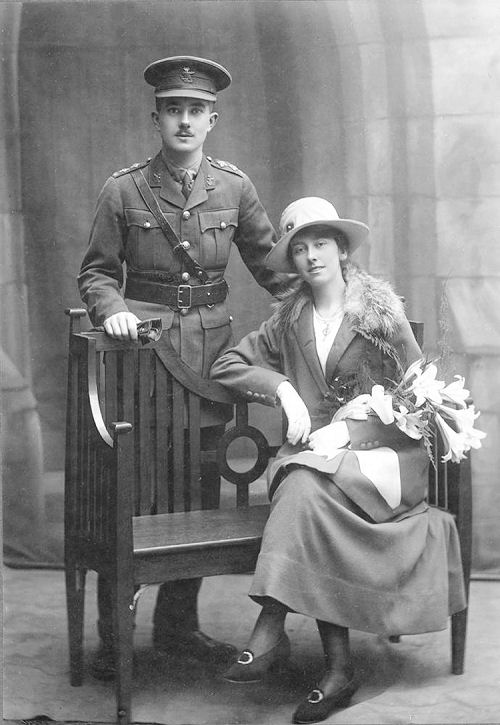
Sometime during this period, Vern proposed to Edith. On 5th January 1918 they married at the Parish Church of All Saints, Clapton, Middlesex, England [click on the image at left], just as Vern was about to be posted once again.
Service in the USA
On 15th February, Vern was seconded to the War Office as a Staff Lieutenant, 1st Class. At first, rumour had it that he was headed for Siberia where other Canadian troops were in service. His first point of transit was Montreal but at the last moment he received notice to join the British Military Mission to the United States. There he was to instruct American troops in camouflage, sniping, range finding and battlefield problem solving. Instead of Siberia, he was dispatched to Fort Sill, Oklahoma. Knowing nothing of this, Edith followed him by ship shortly thereafter, traveling alone to Montreal. On her arrival, a letter awaited her from Vern telling her to follow him to Fort Sill.
Vern remembered his service at Fort Sill as being far removed from the battle and very hot. Captain Price, a career officer in the British Army, headed the Mission. Despite the blazing sun and humid conditions on the parade square, the captain insisted on wearing Sam Browne belting and starched white collars while the Americans wore cotton fatigues. The captain changed his collars sometimes three times a day to maintain appearances, and the American troops thought he was crazy.
Vern completed his American tour on the 26th October 1918 and returned to Canada. He was attached to the 1st Battalion, Central Ontario Regiment, until the Armistice and thereafter reported to District Depot #2 in Toronto. The day after Armistice he received orders "to hold [himself] in readiness to procede [sic] overseas on the first available sailing". Eight days later these orders were rescinded. Vern remained in Toronto until 11th July 1919 when he was struck off strength and discharged from the army by reason of general demobilization. Vern and Edith's first son, John Vernon Charles, was born in December the same year.
Post World War I
While looking for work after his discharge, Vern encountered prejudice against Englishmen. Employment notices often stated "No English need apply", which annoyed him no end. He had been in Canada since 1911, had served in the Canadian Army overseas and had nearly been killed. He considered himself Canadian but was taken for English because he had not lost his accent. Being imaginative, he presented himself as a Canadian who had been educated in England. His employment applications were then more favourably received. In time his English accent gave way to a Canadian one.
In 1923 Vern joined the accounting department of a Toronto based subsidiary of an American cosmetics and pharmaceutical company. He worked there during the depression and near the beginning of the Second World War was promoted to the chief executive position (then Vice President and General Manager) of its Canadian operations. During the same period, he and Edith had a second son, Philip James, in 1929, and a third, Denis Winn, in 1934.
World War II
When WW2 broke out, John, the eldest son, expressed interest in joining the Canadian Army. Vern advised him, "Whatever you do, don't join the infantry. Become a gunner. At least you will ride wherever you go.". John was commissioned in the Royal Canadian Artillery in 1941 and two months later joined the 17th Field Regiment already in England.
Before leaving for overseas in September, Vern had gifts and last minute advice to give his son. He bought a Colt .45 calibre automatic and a down sleeping bag. "The standard issue .38 won't do you any good because it won't stop anyone attacking you. With this (the .45), you can knock a man down no matter where you hit him. I hope you never have to use it but if you do, don't hesitate." The sleeping bag was to replace army blankets for which Vern had low regard.
With his sense of duty, Vern felt he too should volunteer. At the Central Depot in Toronto, he presented his credentials. His expectations of a field officer commission were not met. Instead, the recruitment officer suggested he join the Royal Canadian Army Pay Corps as a paymaster, major's rank.
Vern gave up the idea of active service but remained closely attached to military tradition. He had, in earlier years, joined the Royal Canadian Military Institute in Toronto, was elected a director and was finally made a life member in 1963
Post World War II
In 1947 the New York headquarters of Vern's company had plans for new management. Vern resigned his position in September 1948, after 25 years of service. In the years that followed, he found various employment in the chemical industry, in a liquidation company, with a religious linen supplier and lastly in real estate.
At age 72 (1964), he gave up work and took what pension he could get. He applied to the Canadian Pension Commission for an allowance for his war wound. The Commission rated it at 7% or $9.00 per month.
Last Years
By 1967 Edith's health was failing and Vern had a mild stoke. As he recovered, her condition deteriorated. Vern looked after her with love and affection. After three years, however, Vern could not handle the demands of her care and placed her in a care home. Vern, always faithful, visited her every day. She confided to her son, Phil, that when she had married his father, she never thought things would work out as they had. She and Vern had twenty grandchildren and many great-grandchildren.
Edith died on 22nd May 1979 at the age of 87. She was buried in the graveyard of Saint Philomena's Catholic Church on Howe Island in the St Lawrence River, the home parish of John and his family. After the service Vern remarked: "After 80 years [with her] I can't believe it's over.
Vern had earlier sold the family house and moved to Aurora, Ontario, where he rented a small, second storey apartment in an old house. He attended the Canadian Legion in Newmarket once in a while and went to church on Sundays. He was suffering from glaucoma but was not yet legally blind. Still, he endeavoured to be independent even though he had to give up driving. He made a trip to Ireland with John. And over this period he suffered two minor heart attacks.
Finally, on 10th April 1981 Vern had another attack in the middle of the night and called his son, Denis, for help. An ambulance arrived but Vern died en route to the hospital. He was 88, three months short of his next birthday. After his large family had time to gather, he was buried beside Edith at Saint Philomena's.
Due credit for the extensive and detailed biography, and for the images, is with great thanks to Phil Dowling and Rick Munroe, with help from Kevin Dowling duly acknowledged.